


Threads of Identity and Nostalgia Woven Across Continents by Chiharu Shiota
Transmission 093: Interview with Chiharu Shiota
Shiota Chiharu (塩田 千春) is a performance and installation artist educated in Japan, Australia, and Germany. She has developed largescale installations that reflect women’s living realities, combining performance art, sculpture, and installation approaches. Shiota integrates materiality and emotional awareness of space to explore issues of physicality and flesh, as well as personal narratives concerning consciousness, space, and isolation. Her early works at Seika University in Kyoto, such as “From DNA to DNA” (1994) and “Becoming Painting” (1994), used materials like woollen threads and paint, laying the groundwork for her future creations. Initially, her artworks were performance pieces, many of which have been photographed and videotaped.
These performances often involved materials like dirt, while her later largescale installations incorporated personal artifacts, such as shoes, provided by others. Her signature installations—brilliant, dense networks of threads spanning entire exhibition spaces—propelled her to prominence in the 2000s. She is best known for these roomspanning webs of threads or hoses, which connect abstract networks to everyday objects like keys, window frames, gowns, shoes, boats, and bags. In her artistic practice, materials and colors hold specific connotations, such as the use of menstrual blood as an artistic material and crimson threads symbolizing human relationships. Narrow plastic tubes containing bloodlike fluids may also represent the umbilical cord, suggesting care and the beginning of life. Places play a significant role in her work, and she is particularly interested in psychogeography—the interaction between the psyche and space. Shiota’s thread installations emerged from her experience of moving across locations, leading to a desire to wrap her belongings in yarn, thus establishing a sense of personal space. In addition to creating art, Shiota has participated in communitybased projects and held exhibitions worldwide.
Featured image: During Sleep, 2002, Performance / Installation: hospital beds, bedding, black wool
Kunstmuseum Luzern, Lucerne, Switzerland. Photo by Sunhi Mang. Copyright VG Bild-Kunst, Bonn, 2024 and the artist
Shiota Chiharu’s Official Site, Instagram and Facebook
From Japan, Australia and Europe, what influenced your artistic practice and the themes you explore? Did living and travelling in different parts of the planet influenced the way you see the world and create art?
I was born in Japan and I have been living in Germany for 28 years. The farther away I lived away from my home country, the more I can see myself and my identity clearer. When I lived in Japan, everyone was living under the same culture, and you forget that you are Japanese, only after travelling and meeting people from different nationalities, I knew I was Japanese. But now, I have been living in Germany longer than I have in Japan. I feel like I have two home countries.
Everything I create is from a personal experience but I want to extend it into something universal.

I read that around 12 years old you understand your art life path. Can you share with us about this experience?
My parents owned a small factory, producing boxes for fish. I saw them and the workers, working with machines, like machines themselves. I wanted to do something more spiritual with my life. Even when I was in kindergarten, I would be complimented on my artwork by my teacher. I collected the art column for the Sunday newspaper. I found my path and wanted to become a painter.
What were the biggest challenges at the beginning of your career?
The most difficult time was after I finished my studies. For almost 10 years I did not earn enough from art. I could not live from it. I had to work at a restaurant and apply for stipendiums. It was such a disappointing time. I had exhibitions but I could not pay my rent from them. But I have the feeling that this time was necessary.
She attended Kyoto Seika University in Kyoto, the Canberra School of Art at the Australian National University, the Hochschule für Bildende Künste in Braunschweig, and the Universität der Künste in Berlin.

Installation: mixed media
Kunstraum Dornbirn, Dornbirn, Austria. Photo by Günter Richard Wett
Copyright VG Bild-Kunst, Bonn, 2024 and the artist *

Installation: wool. Hammer Museum, Los Angeles, USA. Photo by Jeff Mclane. Copyright VG Bild-Kunst, Bonn, 2024 and the artist *

Installation: rope, glasses
Museum Haus Konstruktive, Zurich, Switzerland. Photo by Stefan Altenburger
Copyright VG Bild-Kunst, Bonn, 2024 and the artist *
Your artworks involve complex, largescale installations that are both delicate and overwhelming. Can you describe the initial spark of inspiration for these projects and how you translate that vision into such intricate physical forms?
I have to see the exhibition space first, I work from the space. Some of these exhibition spaces already have so much history and accumulated existence because of its memory.
For example, when I was invited to exhibit at Manifesta 14 in Prishtina, I was exhibiting at the former hammam and I invited people to write me letters of their story. I want to connect the memory with the existence with my thread.
Sometimes, the theme of the group show is also an inspiration. The title of the Aichi Triennale was “Still Alive”. I was showing at an old thread factory and included spools of thread within the space as well, it was keeping the memory of the past alive.
Mostly my work is inspired by my personal experiences and emotions on life and death and human existence.


Nizayama Forest Art Museum, Toyama, Japan. Photo by Sunhi Mang. Copyright VG Bild-Kunst, Bonn, 2024 and the artist *

Your artwork blurs the lines between the personal and the universal. How do you navigate expressing deeply personal emotions or memories while creating something that resonates with a broader audience?
I wanted to create an installation including keys, because I wanted to hold something important in my hand. But if I only put 10 keys in the installation it would only be about my own story, it would stay private. But I collected 150.000 keys, it was an accumulation of memory and existence. The amount matters because it is not only my story, it becomes everyone’s story.
In an interview, she mentioned that her first installation work, Becoming Painting (1994), created while she was studying abroad in Canberra, Australia, involved applying red enamel paint to her body

I have read that you have spoken about art as a way to explore and confront existential questions. Can you share with us how your art reflects your understanding of life, and the human condition?
We receive so much information every day we are all in conversation but we still cannot know what the other is truly thinking. Technology and our society has developed so fast, but our body is still the same. We cannot read another’s persons mind or feel what they are feeling. We can only assume. In my work “Where are we going?” and “Uncertain Journey” I reflect on our path and purpose in life. We do not know what journey another person is on but we all travel in the same direction.
In 2015, Shiota was selected to represent Japan at the 56th Venice Biennale

Installation: papers, desk, chair, black wool. K21-Kunstsammlung Nordrhein-Westfalen, Düsseldorf, Germany. Photo by Sunhi Mang
Copyright VG Bild-Kunst, Bonn, 2024 and the artist*

Toyota Municipal Museum of Art, Aichi, Japan. Photo by Kazuo Fukunaga. Copyright VG Bild-Kunst, Bonn, 2024 and the artist*
Many of your artworks explore themes of memory, absence, and presence. How do you choose the objects you incorporate into your installations, and what role do they play in conveying these themes?
My theme is the existence in the absence, I collect old objects like beds, chairs, shoes, because they accumulate memory and therefore existence. In the installation, the human body is missing but when I see the objects, I can see the trace of a body. When a person has died, the memory of their existence is even stronger. The object is not new. But used, it has a lot of memory that is important to incorporate in my installation. I think memory is most important, without memory you cannot explain yourself.

Japan Pavilion, 56th International Art Exhibition—La
Biennale di Venezia, Venice, Italy. Photo by Sunhi Mang. Copyright VG Bild-Kunst, Bonn, 2024 and the artist*


Installation: old keys, old wooden doors, red wool. KAAT Kanagawa Arts Theatre, Yokohama, Japan. Photo by Masanobu Nishino. Copyright VG Bild-Kunst, Bonn, 2024 and the artist*
Thread is a recurring material in your work, creating webs that connect objects and spaces. What does the thread symbolise for you, and how has its meaning evolved over the years?
The thread presents human relationships. The thread itself can be tangled, loose, stretched, tight or cut. This represents our connections and relationships. It is a mirror of my feelings.
In the beginning, the thread was especially an extension of a pencil line or brush stroke on the canvas. I was able to draw in the air, the installation is like a three dimensional painting but it has become more and more about connection and memory.

Kunsthalle Rostock, Germany. Photo by Thomas Häntzschel (Fotoagentur Nordlicht,
Rostock. Copyright VG Bild-Kunst, Bonn, 2024 and the artist*

Installation, white wool, wire, string
Le Bon Marché, Paris, France. Photo by Gabriel de la Chapelle
Copyright VG Bild-Kunst, Bonn, 2024 and the artist *
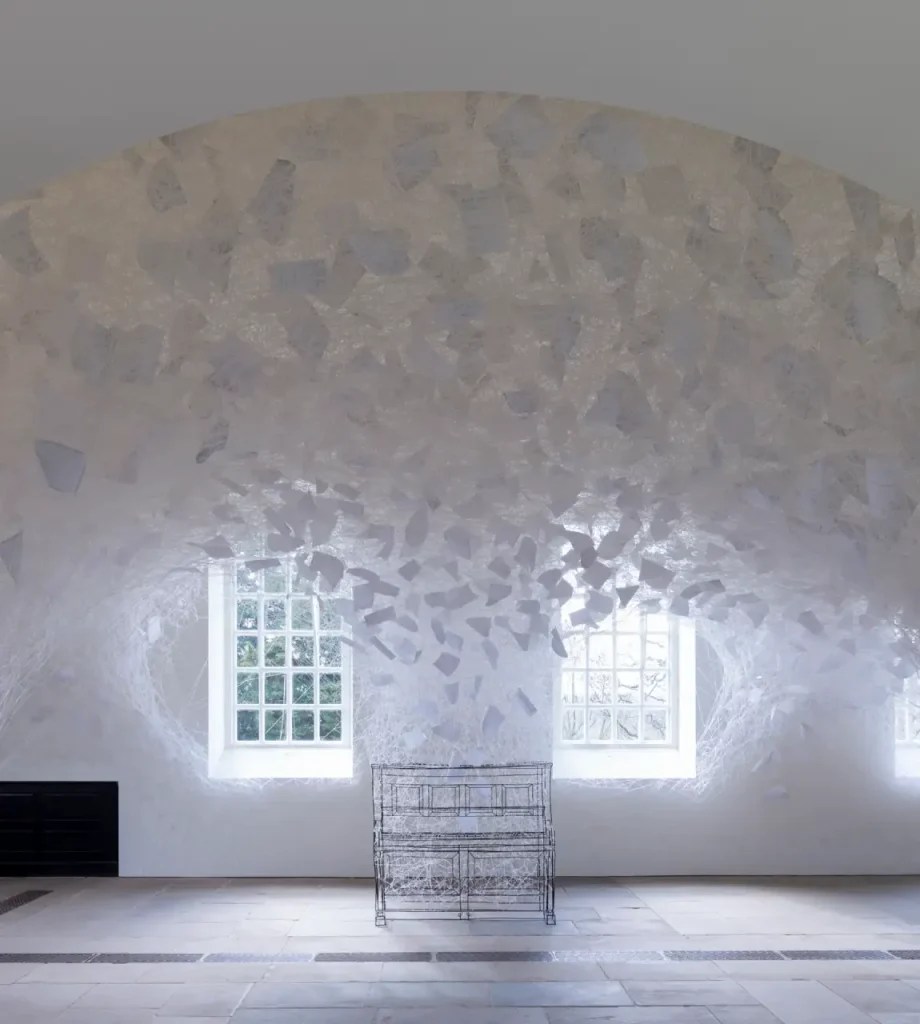
Installation: metal frame piano, white wool, note sheets Yorkshire Sculpture Park, Wakefield, UK. Courtesy Yorkshire Sculpture Park, photo by Jonty Wilde Copyright VG Bild-Kunst, Bonn, 2024 and the artist *
Your installations can also evoke a powerful sense of being caught between spaces or moments. What is your perspective about this theme, and how do you explore this concept through your work? Thread is a connection or can be a cage? Or perhaps a place where growth transforms, similar to the cocoon of a butterfly or a silkworm?
I am using string, but it is an accumulation of lines. I want to create beyond the material. When the people cannot see that it is strong then they can see the meaning behind artwork. It should be like a good painting such as Monet or Rosko. They use oil colour on canvas when you see it, it is much more. When I look at the painting I see something beneath. There is another world. It is not only a string but shows the universe and connection.
The web of threads looks like a neuron system of the brain. And every person is different, some people might see it as a cage or a cocoon. For me, it is about connection with the universe.
Looking back at your body of work, how do you see your artistic practice evolving? Are there any new themes, materials, or techniques you are interested in exploring in the future?
Recently, I started working with more wire and glass. After my second cancer diagnosis, I wanted to work with more lasting material. The glass is created into a natural object like a cell in a body. I feel like I have a universe inside and I want to connect it with the outside universe. And since the pandemic, I have made a lot of drawings with thread as well.
She has reinterpreted her understanding of memory and cognition by immersing everyday objects like shoes, keys, mattresses, chairs, and gowns in massive thread constructs.

Installation view: Shiota Chiharu: The Soul Trembles, Mori Art Museum, Tokyo, 2019. Photo by Sunhi Mang, Photo Courtesy: Mori Art Museum, Tokyo, Copyright VG Bild-Kunst, Bonn, 2024 and the artist

Do you feel more connected with one project that has a meaningful significance for you? If yes, can you share with us the story behind it?
People still come up to me and tell me about their experience seeing my work at the Venice Biennale in 2015. “The Key in the Hand” has a special place in my heart. The red thread has become very significant in my work and has made me more recognizable.


Nowadays we live In a world that is increasingly digital. How do you perceive the role of art in different cultures and societies? Your artwork that has been exhibited worldwide, requires a slow, meticulous process but also a curious and reflective audience and viewers, since you evoke a meditative state. Your installations also have the power to invite viewers to step into and become part of the artwork. What role does the audience play in your artwork, and how do you envision their interaction with your installations? How do you think your art fits into or reacts against the current cultural landscape?
I feel that the relationships between countries have become tenser. Of course, there has been much more war since the pandemic but the pandemic itself has led countries to isolate more. People were only able to experience everything online. And since the borders have been open again I feel that people want to experience more in person and connect to another.
However, my work is much more personal and not political. I think people connect to it in a more personal or spiritual way. But each exhibition venue is different. I think contemporary art does not have a single answer, everyone will see something differently.

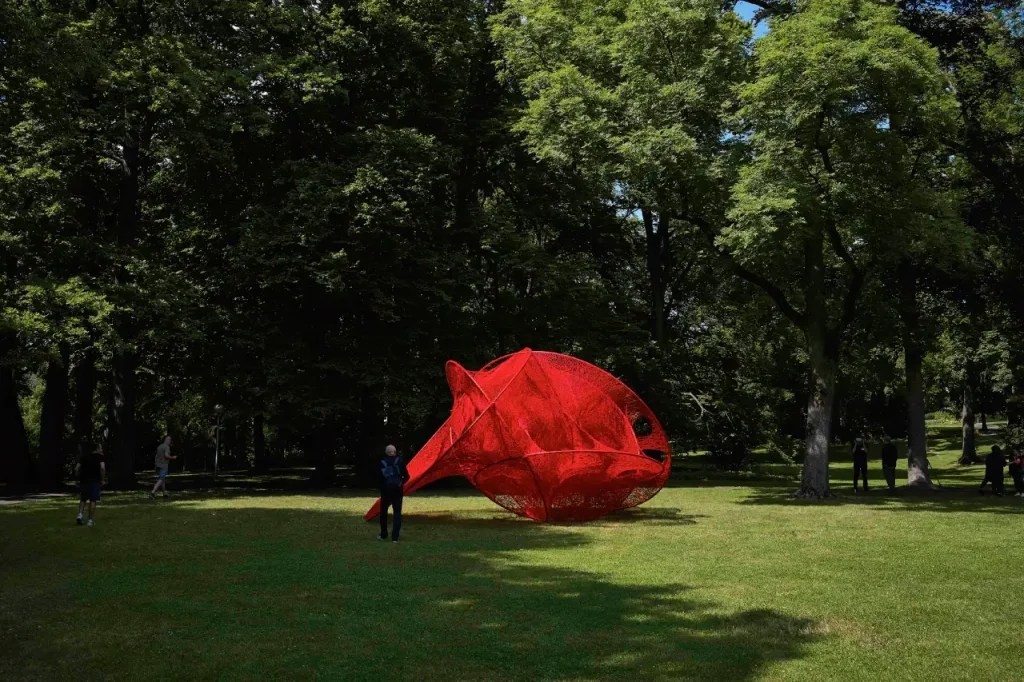
Installation: metal frame, wool, WinX Tower, Frankfurt/Main, Germany
commissioned by WinX GmbH & Co Immobilien KG, Bad Homburg, Photo by Klaus Helbig, Copyright VG Bild-Kunst, Bonn, 2024 and the artist *
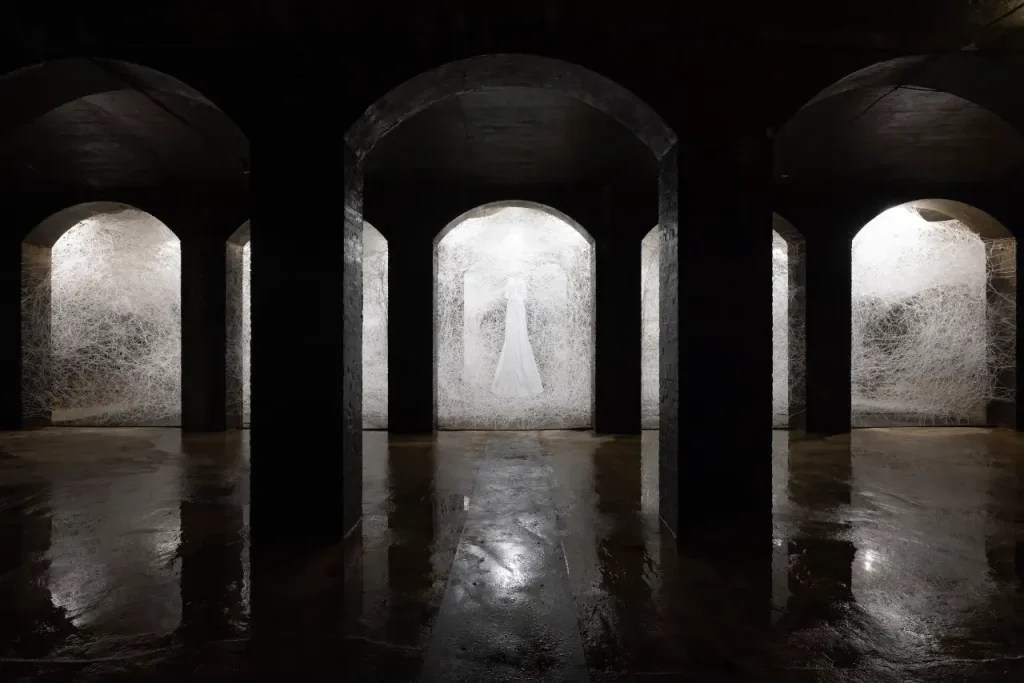
Photos courtesy of Shiota Chiharu

Ciao! My name is Dominique. I’m Italian and I’m proud to be a mix. My father was an Italian chemical engineer and high school teacher, with Greek and Polish heritage. My mother is Haitian, she was high school language teacher, with Dominican, Spanish, French, Portuguese, African and Native American heritage. Being a mix makes me appreciate to want to understand different cultures and lifestyles. I grew up in Italy, lived few years in Haiti, travel around main European capitals, lived many years in China, in Spain and UK. Traveling makes me feel that we can learn something from every situation in every part of the world.
Discover more from RetroFuturista
Subscribe to get the latest posts sent to your email.
