


Joon Yong Moon is a new media installation artist renowned for his interactive shadow work.
Transmission 245: Interview with Joon Yong Moon
Joon Yong Moon, better known by his stage name Joon Moon, is an expert in experimental media and computational art, which includes generative art, augmented reality, tactile interfaces, and shadow/light installations. He is a pioneering new media artist whose interactive installations explore the poetic and psychological dimensions of shadow and light. Trained at Parsons (MFA in Design & Technology), his signature Augmented Shadow series uses physical objects and AR-driven shadows to create immersive ecosystems and stories. His creations question perception and transport spectators to worlds where presence, absence, and imagination come together, as shown in the close-knit, tactile interactions of his tabletop pieces and the full-room illusions in “Chasing Stars in Shadow.”
His work explores the ways in which shadow may serve as embodiment, story, and interface. He encourages viewers to co-create immersive worlds in the intersection of virtual and real light using AR-enhanced shadows. Space is transformed into an evolving theater of interaction and imagination in his work, which explores the lyrical interplay between presence and absence. His work has received significant honors such as the Japan Media Arts Festival Excellence Award and the STARTS Prize nomination, and it has received international recognition, having been displayed at MoMA, Ars Electronica, SIGGRAPH Asia, and numerous major media art festivals. With a patent-backed methodology and an evolving visual language, Joon Yong Moon is pushing and expanding the creative boundaries of shadow storytelling and physical interfaces.
Joon Yong Moon’s official site | Instagram | Facebook
What first brought you to working with shadow as a central medium of your art? Was there a formative moment that ignited it? Can you share with us more about it?
It all began with my Master’s thesis work at school, “Augmented Shadow,” back in 2010. I was studying Design & Technology and wanted to find my original artistic language. While learning and researching different computational art techniques, I discovered that using shadows could create an immersive experience similar to augmented reality, plus offer unique artistic interactions.
So, I started calling it Augmented Shadow, developed the necessary software and hardware myself, and made an experimental piece. Luckily, this first work got popular quickly and led to many exhibition invitations. At that time, new interaction technologies like AR and tangible interfaces were developing fast, but there weren’t many cases where the interaction itself was designed as art. I think that’s why my work stood out. That pushed me to take my art more seriously and see more possibilities with shadows. I’ve been developing new works ever since, and now shadows have become the heart of what I do.

Which artists, architects, or thinkers have influenced the way you understand shadow, light, and space?
There isn’t one specific person. I’m influenced by all kinds of modern visual arts, including fine art, film, comics, games, and advertising.
Shadow is often associated with mystery, memory, or the subconscious. What role does memory play in your shadow-based environments?
Shadows are something people intuitively understand from childhood, shaped by their life experiences. I invite viewers to engage with my work through familiar light-and-shadow play.
Everyone meets my work in a way they already know, and then they experience it, and interpret it differently based on their own memories.
Joon Yong Moon’s project, Hello, Shadow! (nominee for the 2019 S+T+ARTS Prize): An advancement that combines reality and imagination with AR-generated shadows, where users manipulate a physical light source to reveal virtual shadow worlds


How do you choreograph light in your installations? Is it more like painting, composing, or designing a space? Do you think of your installations as worlds, stories, or poems?
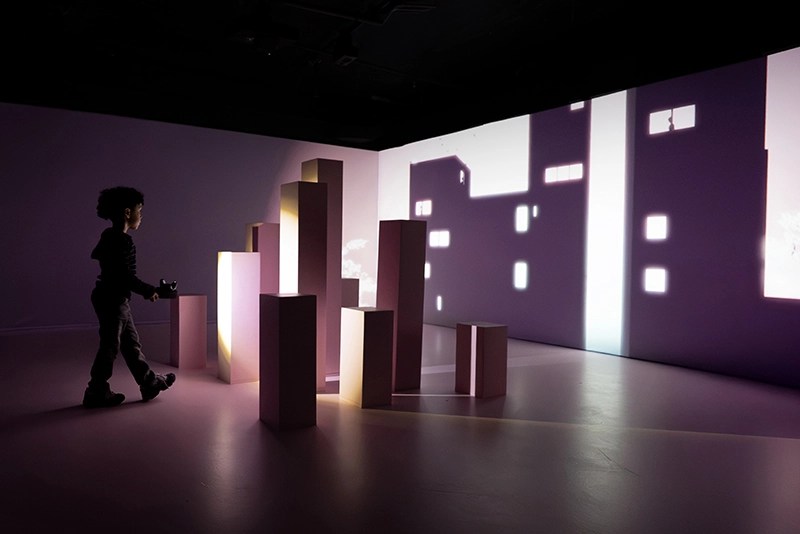
In my works, shadows are drawn as the viewer moves a lamp. So I design with light, shadow, space, and the viewer’s movements all in mind. Usually, the space has physical limits, so I start by setting the space to allow as many possibilities as I can. I arrange objects and lights carefully so the shadows form as I want. Because eventually the light will be controlled by the viewer, I place objects considering many possible interactions. This way, a shadow world is created inside the real space, and viewers join it through their lamp. Since everything is drawn with shadows, the world feels poetic—that’s its biggest charm. My installations are like worlds, stories, and poems all at once. Your word “choreograph” fits perfectly—I think of it as choreographing the audience to create art in my world.

You’ve developed patented technology around augmented shadow, do you see yourself as part inventor, part artist? What does “augmented shadow” represent to you: technically, philosophically, and poetically?
It’s very important to me that I create art using technology I developed myself. Technology expands the scope of art. So I believe there’s great value in developing the technology myself, using it to create art, advancing that technology further, and then producing even better work through that process. I got a patent for Augmented Shadow as proof of this process. Besides, since this technology is used only by me, it guarantees the originality of my work.
To me, philosophically, Augmented Shadow explores the boundary between reality and the virtual, presence and absence. My shadows appear to exist because they feel so real, but they don’t actually have any physical substance. Even after we realize that, once we deeply interact with this shadow world, it starts to feel even more real. This makes me rethink how we perceive and experience reality.

How do you think digital interaction affects our relationship with absence, silence, or things unseen?
Digital interaction is deeply changing those things. The focus of digital interaction design is often on functionality, convenience, and the enjoyment of what can be seen—rather than things unseen. This tendency becomes even stronger as new technologies are used. My shadow works are distinct because they communicate with viewers in a very different way. My shadow encourages people to imagine what lies beyond what they see. My interaction design invites viewers to use their imagination during the experience. It also offers a poetic quality. I want to show that digital technology, computers, and new tech can be lyrical and poetic.
The immersive room-scale experience Chasing Stars in Shadow (2022) has shadow “kids” that transition between 2D and 3D. When participants direct their light, a 14-minute tale with interactive storytelling, optical illusions, and emotional involvement is triggered.


Your work merges physical light, digital projection, and interactivity. How do you prototype such layered experiences? How do you navigate the relationship between code, design, and intuition?
Since I have to design many things and do coding and hardware engineering too, the production process is complicated and all parts are connected—if I change one thing, I often have to adjust others. The interaction part is especially challenging because viewers always behave unpredictably, and it’s hard to design something that perfectly matches their intuition. So testing prototypes with viewers is essential. But a few tests before the exhibition aren’t enough, so in real life, I keep watching how viewers interact during every show and make updates.
There’s often a childlike sense of wonder in your work, especially in how people interact with shadow creatures. How important is play in your process?
An important part of my work is that the viewers have to be part of the shadow world by moving the light. It has to be easy and fun so people want to do it willingly. Using light shouldn’t be difficult or require learning. That’s why I made it so anyone can join my shadow world with familiar play. I want people to spend time in my world without even realizing it. I also want my art to be easy and fun for everyone. I hope people feel joy, understanding, and meaning through their own experience without me explaining.


Do you design your installations with specific viewer reactions in mind, or do you let interaction reveal the story on its own? Have you ever been surprised by how someone engaged with your work, maybe in a way you didn’t expect or design for?
I try to let viewers find the story on their own, in an intuitive way. I keep rules minimal and make the work easy to understand without explanations. Sometimes I guide viewers toward certain reactions, but because people behave so differently, it’s impossible to control every detail.
One of the most joyful surprises came from my piece Chasing Stars in Shadow—there’s a scene where characters leave the viewers, and I saw many viewers spontaneously waving their hands to say farewell. It showed me they had truly engaged with the characters on a deep level, which I hadn’t expected. I think it’s because the piece encourages viewers to share their own light with the characters, making the interaction feel personal.
Projects like Chasing Stars in Shadow unfold over time like short films. How do you think about pacing, story, and emotional arc in spatial works?
That work can be described as time-based storytelling in an immersive environment using large-scale projection. There aren’t many similar examples yet, so I’m enjoying the process of experimenting. I hope more artists will try it, so we can exchange ideas.
I feel this kind of storytelling is closer to stage plays than screenplays. Even though a projector or stage set can present different scenes, the physical space remains the same. Conventional stage plays use various techniques to overcome this limitation, and I think similar techniques might be helpful here too.
His interactive tabletop project called Augmented Shadow (2010) creates a live shadow environment by using real blocks to generate shadows that change into virtual trees, buildings, and animals. By moving blocks and fusing the virtual and real worlds, viewers can influence the plot.


You’ve said shadow is more than visual, it’s a narrative and emotional language. How did you come to see it that way? Where do you see the future of augmented shadow going? Could it live outside the gallery, in homes, cities, schools?
I see shadow as a narrative and emotional language because of its power to spark the imagination. Shadows emerge and vanish with light, shifting and distorting depending on the perspective. This allows our imagination to create stories. In my works, shadows appear as living beings that engage with viewers and make stories together. I’m fascinated that shadows—an artistic subject since ancient times—still hold so much potential for exploration through new technologies. They’re also a medium that resonates universally across cultures. I’ve been exploring ways to bring Augmented Shadow beyond gallery spaces. Recently, my work was officially invited to several VR film festivals.
Photos courtesy of Joon Yong Moon

Ciao! My name is Dominique. I’m Italian and I’m proud to be a mix. My father was an Italian chemical engineer and high school teacher, with Greek and Polish heritage. My mother is Haitian, she was high school language teacher, with Dominican, Spanish, French, Portuguese, African and Native American heritage. Being a mix makes me appreciate to want to understand different cultures and lifestyles. I grew up in Italy, lived few years in Haiti, travel around main European capitals, lived many years in China, in Spain and UK. Traveling makes me feel that we can learn something from every situation in every part of the world.
Discover more from RetroFuturista
Subscribe to get the latest posts sent to your email.
