

Misogynist and alpha communities took the look of rebellion and left behind everything the original works were fighting.
- From The Matrix to Fight Club, from V for Vendetta to GTA VI: symbols born against power and adopted by those who defend it
There is a paradox running through the pop culture of recent decades. Works created to attack power, capitalism and sexism are adopted by the very people who defend those things. What remains of these works is the aesthetic, made of leather jackets, muscles, sweat, rage, weapons and harsh language, while the message is thrown away. The misogynist, alpha and incel communities, together with the cultural right that shares their enemies, have built a large part of their imagery on titles they have not understood, or have chosen not to understand.
Talking about cultural appropriation is not a stretch. In the classic sense the term describes a dominant power taking from the marginalized and emptying out what it takes: it happens with hip hop, and it happens when symbols created by trans people are wielded by those who would like to bar them from the military. Here the mechanism is the same, applied to rebellion: a language born to fight a system of values is stolen by those who defend that system. Not all cases are the same. Some are sincere misunderstandings, others are acts of outright bad faith, others still are simple selective nostalgia. One common thread remains: the aesthetic of rebellion is separated from its target.
These cultural misunderstandings, more or less deliberate, have sometimes also helped push creators to distance themselves from their own works, as in the most famous case of Alan Moore, who disowned Watchmen and V for Vendetta and makes no secret of his irritation with the fans who misread them, starting with those who admire Rorschach.
The Matrix, the most blatant theft
The case of The Matrix is almost textbook. The Wachowski sisters have confirmed that the film should be read as an allegory of trans identity. The entire imagery of the “red pill” was therefore born in a work directed by two future trans women and written to question power structures and imposed identities. Yet it has been seized by champions of ultra-traditionalist and misogynist views, who have made it their own language.
In the film, taking the red pill means choosing to see the reality hidden behind a system of control, even if it hurts. In the language of the manosphere the same expression has become adherence to a view in which society is supposedly rigged in favor of women and feminism has deceived men: whoever “takes” it considers himself awakened. Incels push the concept further with the “black pill,” the fatalistic conviction that physical appearance and success with women are determined irreversibly and that nothing can be done. An allegory about liberation from imposed identities has thus become the manifesto of those who want to impose an identity and a role on others.
Keanu Reeves himself, asked by The Guardian in 2024 about the alt-right’s use of the metaphor, looked uncomfortable: “It doesn’t sound that great to me?” Four years earlier Lilly Wachowski had already rejected that reading, answering a tweet by Elon Musk that urged people to “Take the red pill.”
When satire is taken literally
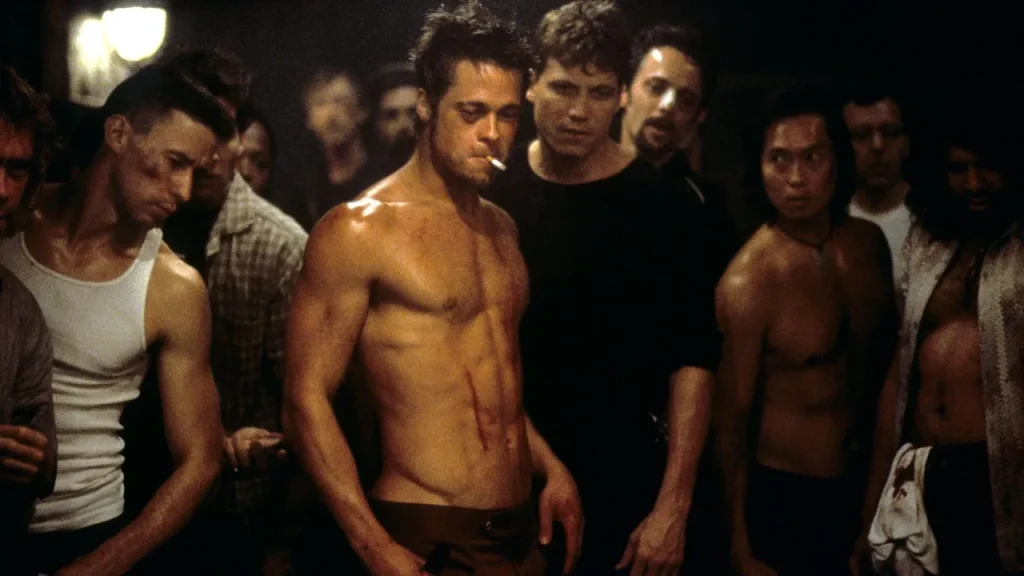
Fight Club and A Clockwork Orange present two pathological figures, Tyler Durden and Alex DeLarge, built as a critique of violence, consumerist emptiness and the cult of the leader. Many have turned them into models to imitate, taking the satire literally. In the case of Fight Club the film seduces on purpose, and whoever stops at Brad Pitt‘s gleaming abs has seen only half of the work. It also says a great deal, incidentally, about their idea of masculinity.
American Psycho (2000) is directed by a woman, Mary Harron, and based on a novel by Bret Easton Ellis, a gay writer. It is a ferocious satire of the empty, pathetic narcissism of 1980s high finance. Patrick Bateman has nonetheless become the supreme mascot of the “sigma male” cult and of redpill culture.
Starship Troopers (1997) is an explicit parody of fascist militarism, with Paul Verhoeven dressing the Federation in uniforms with a clearly Nazi flavor and surrounding it with grotesque propaganda. In September 2026, Trump posted on Truth Social an AI-generated concept for a “next generation” Space Force dress uniform, captioned as “inspired by the discipline and functionality of the Starship Trooper uniform.” The satire has been taken literally by the head of state.
Joker (2019) was born as a tragic portrait of social abandonment and cuts to mental health care. In many corners of the web Arthur Fleck has been adopted as a banner for misogynist resentment and violent revenge.
Heroes who were not heroes
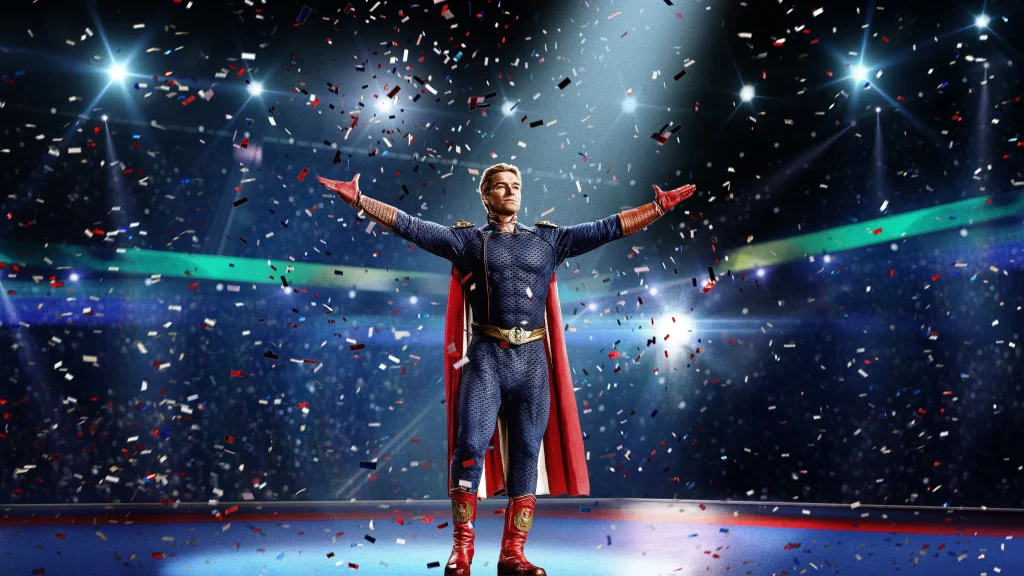
In The Boys, Homelander is written as a narcissistic and violent caricature of authoritarian nationalism. For several seasons part of the audience cheered him as a real hero, conveniently ignoring every sign to the contrary, and there was no shortage of social media comments glorifying him. When in 2022 showrunner Kripke made the connection to Trump explicit, some right-wing fans were unhappy. Co-creator Darick Robertson, interviewed by Retrofuturista, recalled that “Anyone can put on a Superman costume, it doesn’t make you Superman.”
The skull of The Punisher is printed everywhere by paramilitary groups and hardline supporters. Rorschach, the vigilante of Watchmen, has also ended up at the center of similar readings. In our interview, Alan Moore says the disowned work mostly reveals “a limit to the audience for super-heroic adventure stories.” And he adds: “a majority of my comic work has probably never been understood. This is not their fault or mine, it’s just a misunderstanding.”
A similar fate befell V for Vendetta. The Guy Fawkes mask and the aesthetic of the masked avenger are used by movements of every kind, forgetting that Moore’s comic is an openly anarchist and antifascist manifesto, with central queer subplots. Artist David Lloyd, in our interview, acknowledges that the mask has become “a neutral symbol of resistance,” adding however that “it’ll always represent the fight against that particular form of oppression.”
Cyberpunk, neon and conspiracies
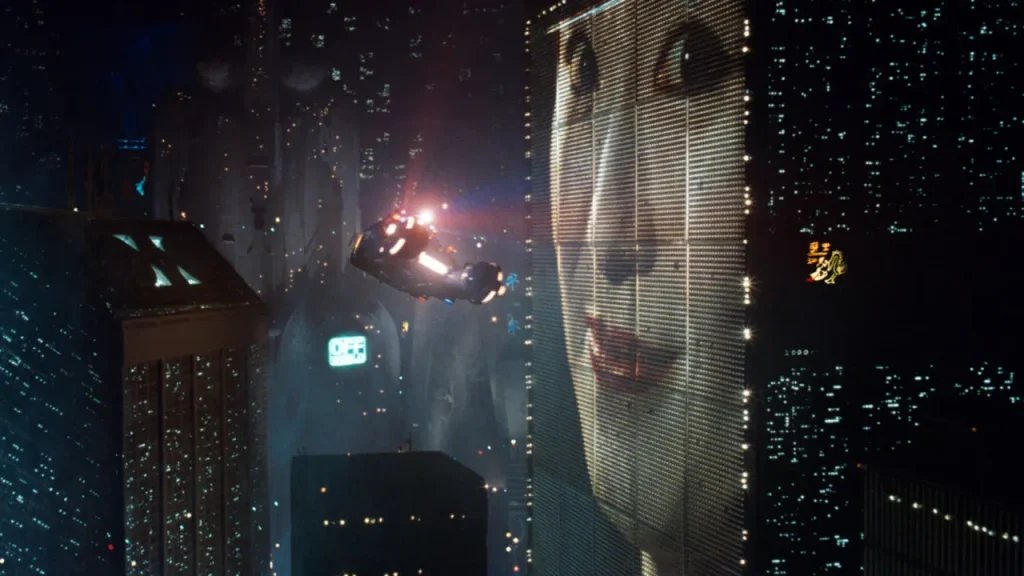
They Live, Blade Runner and cyberpunk as a whole are stories viscerally critical of megacorporations, exploitation, racism toward the “different,” namely the replicants, and social control. They are stories in which those in command own everything, including the lives of those who work for them, and in which those at the bottom discover that their condition depends on a system built elsewhere. Instead they are reduced to a mere neon aesthetic or to conspiracy fantasies, as if glowing signs and nighttime cities were enough to make a world worth admiring. What gets left out is exactly what those worlds denounced: powerlessness in the face of a power nobody sees, and the inhumanity with which the last are treated.
In any case, the perpetual haze and rain in Blade Runner aren’t just atmospheric effects meant to evoke some cool “retro” vibe. Within the film’s world they are the visible sign of a city choking on its own pollution, the kind of ruin those grumbling environmentalists keep warning us about.
Peter Thiel and Middle-earth for sale
The most emblematic case of all is perhaps that of Peter Thiel, cofounder of PayPal and of Palantir Technologies. The company, founded in 2003 and active in data analysis and surveillance for governments, takes its name from the palantíri of The Lord of the Rings, the indestructible seeing stones that allow one to observe distant events. In the novel by J.R.R. Tolkien those objects are a trap: one of them falls into the hands of Sauron, who uses it to spy on, demoralize, seduce and corrupt his enemies, and in this way bends the wizard Saruman to his will. The man who chose the name of his surveillance company from an object that, in the book, corrupts whoever uses it was a devoted reader: Thiel has said he has read the saga at least a dozen times.
It is not an isolated case. Thiel has given Tolkien-inspired names to several companies, from Valar Ventures to Mithril Capital, from Rivendell One to Lembas, and Palantir’s offices in Palo Alto are informally known as “the Shire.” In his orbit there is also Anduril Industries, the military technology company founded in 2017 by Palmer Luckey, the creator of Oculus, and Trae Stephens, a Palantir alumnus. It is not a Thiel company, but it is funded by his Founders Fund and staffed by former Palantir employees. The name is that of Aragorn‘s sword, reforged from the shards of Narsil, the blade with which an ancestor of Aragorn cut the Ring from Sauron’s hand, and in Elvish it means “Flame of the West.” Today that name is the brand of software and systems for armies, and Luckey has said in public that every country needs a “warrior class” excited to enact “violence on others in pursuit of good aims.”
The distance from the book is enormous. The Lord of the Rings is a story about power that corrupts, about refusing to wield the Ring and about the price of war, and the critics of Thiel and Luckey point out precisely that Tolkien detested war. For the two men, using the terminology of Middle-earth is instead a tribute to the libertarian philosophy they see in that world. They took the objects of power from the work and ignored its warning, turning them into brands to sell to governments and armies. Activists have summed it up with a slogan: “You can’t save the Shire if you work with Sauron.” Here the borrowed language reaches the rooms where it is decided who gets watched.

Music and video games: slogans without context
It is almost comical to see people take offense because Tom Morello or the members of Rage Against the Machine hold radically left-wing or antiracist positions, as if the band’s name did not declare from day one which “machine” they are playing against. Evidently they cannot listen to the lyrics of “Killing in the Name” while dancing, distracted by the driving rhythms of the track.
Born in the U.S.A. by Bruce Springsteen and Fortunate Son by Creedence Clearwater Revival are among the most antimilitarist songs and the most critical of the treatment of Vietnam veterans, yet they regularly resound at nationalist rallies and military parades because they have powerful choruses.
In industrial music, misunderstanding can even be a project. We asked Laibach what the biggest challenge was in the beginning, and in our interview the answer was: “Public misunderstanding was inevitable; we designed it that way. The real challenge was surviving long enough for everyone to realise we meant it seriously.” The roots of KMFDM are also anything but reactionary: Sascha Konietzko told us that as a teenager he read “Bakunin, Marx, Engels, stuff to do with Anarchy, Urban Guerilla,” and that Hau Ruck remains “a rallying cry for change” (interview).
In video games, Bioshock and Fallout stage the collapse of unbridled capitalism, with Andrew Ryan in Rapture, and of American atomic nationalism, with Liberty Prime as a parody of Cold War propaganda. In both games the villains’ speeches are built to sound convincing: Ryan’s slogans celebrate the individual free from every constraint, Liberty Prime’s celebrate the homeland, and the player is meant to notice how hollow they are in front of what they see around them.
At a nationalist rally or in an online forum, the move is identical: keep the slogans, drop the critique.

Selective nostalgia and fear of the “woke”
Ellen Ripley of Alien and Sarah Connor of Terminator have become uncontested icons even for those who today would cry “forced feminism” if similar works came out in 2026. Nostalgia filters out the rupture those characters represented at the time. Moore, in our interview, defines it bluntly: “Nostalgia is, and always has been since the word was first coined, an illness.” According to him, as the world becomes more complex and overwhelming, more and more people evade the responsibility of building a tolerable present and seek refuge in an imagined idyllic past or in their own childhood, when they felt safe. On the link with authoritarianism, he recalls that in his short story Illuminations a character wonders whether fascism has always been “weaponised nostalgia.”
The reaction to Barbie in 2023 shows the pattern clearly. Conservative commentators branded the film “woke” or “anti-man,” and Ben Shapiro opened a 43-minute video review by setting Barbie and Ken dolls on fire. The stunt would not look out of place as a GTA cutscene.
And the series itself has now become a target of the same outrage. GTA VI, released on November 19, 2026, was accused of being “woke” from the very first trailer because one of its two protagonists, Lucia, is a woman. Among the complaints were the presence of Black and Hispanic people in Vice City and the fact that players can no longer hire prostitutes. According to Vice, YouTube videos announcing the game’s failure because of its alleged “woke” politics were circulating a year before the trailer. After the release, parodies such as “Grand Feminist Auto” appeared, and some pointed out that GTA San Andreas, back in 2004, already contained Pride flags. The actor Ned Luke, the voice of Michael in GTA V, called “clowns” those who are scandalized by Lucia’s presence.
A shared culture war
Incels see themselves as victims of the “chads,” while the alpha and pick-up artist (PUA) world sells self-improvement and dominance.
A brief aside is needed here. Literature and music have always looked kindly on those who live at the margins, on those who feel excluded from the group: the lonely boy, the eccentric, the nerd.
Incels belong to this family, or to its embittered version. They take the symbols of outcasts but refuse the empathy those stories offer: attention narrows to one goal, the most admired girl, and victimhood hardens into an identity. Here lies the difference with other forms of prejudice, which feed on ignorance: incel communities often have the means to question their own story, and much of their ideology is built to avoid doing so.
Yet these galaxies have allied with one another and with the cultural right, and have turned their relationship with pop culture into an ideological war. It is the logic behind branding as “woke” anyone concerned about climate change, anyone who is vegan, anyone who dares to think that empathy is a value and not a weakness: the word works as a single label for anything that bothers them. What gets lost in the process is that empathy, the quality they mock as weakness, is exactly what stories about outsiders have always offered as a way out of isolation.
Pop culture, after all, often works as a mirror. Viewers take the surface they like, namely strength, rage, rebellion, and ignore that this rebellion was aimed against the value system they defend today.

Matteo Damiani is an Italian photographer and author. Curator of the sites Retrofuturista.com; weirditaly.com; china-underground.com and others
Discover more from RetroFuturista
Subscribe to get the latest posts sent to your email.
